
I’ve been fascinated with mechanical clocks since I was stationed in Nuremberg, Germany, so long ago. Indeed, in the city center, Frauenkirche stands, a beloved 14th-century church and national landmark. However, a further attraction to this Gothic church is its mechanical clock with these curiously entertaining automatons. Each day at noon, these mechanized figures come alive to honor a statue of Charles IV. Although this mechanical timepiece is quite famous, there are many, many others across Europe. Some are more famous and elaborate, such as the medieval astronomical clock in Prague. So, without further delay, please look at 10 of Europe’s most famous mechanical clocks.
Mechanical Clocks to See in Europe
Anker Clock (Ankeruhr)
Hoher Markt 10-11
1010 Vienna, Austria
www.wien.info/en
If you are in Vienna, see the Anker Clock at noontime. That’s because you’ll be able to see all 12 Apostles as they parade through the clock. Adding to the public display is soaring music from Joseph Hayden’s “The Creation.” Although noon is the highlight, there are hourly bell ringing and accompanying musical presentations. However, only one of the 12 figures and a different musical theme will appear.
Hoher Markt
Completed in 1914, Ankeruhr can be found in the historic Hoher Markt. This Art Nouveau clock further acts as a footbridge to connect two buildings. Also known as Anker or Anchor, the clock comes from a Swiss insurance company, Der Anker. The company’s name has since changed to Helvetia Insurance.
Related: Famous Opera Houses In Europe
Clock Tower of Venice (Torre dell’Orologio)
Piazza San Marco
30124 Venezia VE, Italy
Like many famous mechanical clocks, the St. Marks Clocktower has figures parading around in a circular pattern. On the other hand, you may not be able to see the Three Magi, who follow an angel with a trumpet. The Magi and angels only appear twice yearly, at Epiphany and Ascension Day. Although this may be true, you can still see bronze jacquemarts striking the bell atop the tower. Known as the “Moors,” the sculptures strike the bell each hour on the hour.
Piazza San Marco
The Renaissance-era Torre dell’Orologio is among the many classic structures within Piazza San Marco. The Clock Tower of Venice dates to the late 15th century. In particular is the giant bronze bell itself, cast in 1497. The two bronze figures represent an older adult and a young person to reflect the passing of time.
Related: Best Family-Friendly Attractions in Amsterdam
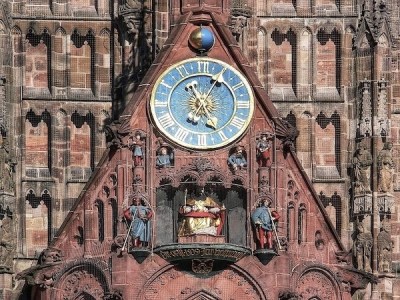
Frauenkirche
Haupmarkt 14
90403 Nuremberg, Germany
www.tourismus.nuernberg.de/en/
The Männleinlaufenn of Nuremberg’s Church of Our Lady may not be as famous as Munich’s Glockenspiel. Nevertheless, the clock of Frauenkirche predates its counterpart in southern Bavaria. It may surprise you, but it’s several hundred years older. You can see the delightful automatons daily at noon when the clock’s mechanism is reactivated. The mechanized procession commemorates a religious degree known as the Renaissance-era Golden Bull of 1356.
Nuremberg City Square
The Church of Our Lady is literally in the heart of Nuremberg’s oldest section. Built-in 1362, it is one of the city’s three churches erected during the Middle Ages. The Männleinlaufenn was installed in 1509. During the holidays, Frauenkirche takes center stage when it overlooks Nuremberg’s famous Christmas Market.
Related: America’s Best Christmas Markets
Lund Astronomical Clock
Kyrkogatan 6
222 22 Lund, Sweden
www.kulturportallund.com
Unlike many others, you can see this astronomical clock inside a building. In this case, it’s housed in one of the oldest stone buildings in Sweden. Also known as Horologium mirabile Lundense, the clock of Lund Cathedral dates to 1425. It would be best to stop by at noon to see the figures dancing to the trumpeters. Equally important are the two clashing knights, signaling the top of the hour.
Stortorget, Lund
Like many of Europe’s medieval clocks, Horologium mirabile Lundense is in the city center. In fact, several important structures are within one another from the Stortorget, or city plaza. For instance, there is Lund University and the King’s House. Established in the 10th century, Lund is one of the oldest cities in Scandinavia.
Paroisse Notre-Dame De Dijon
2 Place Notre Dame
21000 Dijon, France
Dijon may be best known in America for its tangy mustard sauce. But if you visit this ancient capital of Burgundy, make sure to see this early 13th-century gothic church. For one thing, you can admire the stunning architecture and famous Notre-Dame de Bon-Espoir wood statue. Equally important is to see Jacquemart ringing the clock’s bell. The original automaton was installed in 1383, while a wife and children were eventually added.
Dijon Historic City Center
Several historic landmarks bound the Notre Dame Cathedral of Dijon. In detail are Tour Phillipe le Bon, Burgundy Palace, and St. Michael. Even more attractions for you are the Museum of Fine Arts and the ca n’t-miss Central Market.
Related: London’s Most Famous Public Markets

Prague Astronomical Clock
Staroměstské nám.
1, 110 00 Prague, Czech Republic
The most famous astronomical clock is probably in Prague. Known as the Orloj, the Prague astronomical clock is the world’s third oldest. Moreover, at over 610 years, it’s the world’s oldest operating clock. World-renowned for its astronomical capabilities, it also features automatons. At the top of each hour, a mechanical skeleton begins the bell ringing. The doors then open, revealing the 12 apostle automatons, including St. Peter, holding a key.
Historic City Center
The historic City Center of Prague is undeniably a UNESCO World Heritage Site. Within this noteworthy area are the city’s most important structures. In addition to the Astronomical Clock, you will see Prague Castle, Old Town Square, and Charles Bridge. During its Gothic and Renaissance periods, Prague was the capital of Bohemia.
Rauthaus-Glockenspiel
Marienplatz 8
80331 München, Germany
www.muenchen.de/int/en
If you had to choose just one mechanical clock to see its automatons, go to Munich. There, in the historic Marienplatz, you will see the Rauthaus-Glockenspiel. What’s more, this famous attraction has not one but two levels of rotating automatons. These mechanical devices perform daily at 11 a.m. and 12 p.m. However, if you visit during the summer, there is an additional performance at 5 p.m.
Marienplatz
The Marienplatz is Munich’s central square and dates to 1158. If you use the tram for public transportation, a Marienplatz (Theatinerstraße) stop is nearby. Before or after seeing the Glockenspiel, visit the famous, two-domed Frauenkirche. It’s visible from the Marienplatz. Later on, stop by the equally renowned beerhall, Hofbräuhaus München.
St. Mary Steps
West St.
Exeter EX1 1BB, United Kingdom
Historic Exeter is home to more than just one mechanical clock. Most notable is the astronomical clock of the Romanesque-styled Exeter Cathedral. But then again, there’s also the Matthew Miller Clock of the Church of St/ Mary’s Steps. At the top of each hour, you can see the automatons come alive from this ancient clock. Matthew the Miller bows as each bell is rung, with his two sons on either side.
Historic City Center
You can find the Matthew the Miller clock in the historic city center. The River Exe is just minutes away, as the Medieval Ex Bridge. Additionally, you can find Exeter Cathedral nearby and the Royal Albert Memorial Museum & Art Gallery.
Strasbourg Astronomical Clock
17 Pl. de la Cathédrale CEDEX
67082 Strasbourg, France
www.visitstrasbourg.en
The third installation is the astronomical clock, which you can see inside Notre Dame Cathedral in Strasbourg. However, it is no less critical than its two predecessors, with the first installed in the 14th century. The highlights of this third version are the automatons above the clock. Equally fun is that the animation begins at 12:30 p.m. rather than your typical noon. In this case, death rings a bell before the 12 Apostles greet Jesus Christ. Lastly, don’t be alarmed when the roosters crow.
Grande Île
In the historic city center, the Notre Dame Cathedral of Strasbourg lies on the Grande Île (Large Island). Anchoring this UNESCO World Heritage Site, the cathedral was the world’s tallest building for over 200 years. Even today, Notre Dame Strasbourg is the world’s sixth tallest church and tallest built during the Middle Ages. Additionally, UNESCO added Neustadt (New Town) to the World Heritage Site.
Zytglogge
Bim Zytglogge 1
3011 Bern, Switzerland
www.switzerlandtourism.com/Zytglogge
When you see automatons, they are minstrels, royalty, and religious figures. On the contrary, Zytglogge is not your typical mechanical clock. Indeed, it has a centuries-old astronomical clock, a nobleman, and dancing bears. Moreover, there is a crowing rooster and two bell ringers in the steeple to kick off the presentation. You can see these performances every hour on the hour.
Old City Bern
The medieval section of Bern, known as Old City, is a UNESCO World Heritage Site. In addition to Zytglogge, you will find several essential landmarks. For example, the Münster of Bern (cathedral), Parliament buildings, and Nydegg Church are all in the Old City. While visiting the capital of Switzerland, you should see Bear Park (Bärengraben) and the Federal Palace.
Related: Seven UNESCO Works of Antoni Gaudí
About The Author
Randy Yagi is an award-winning freelance writer who served as the National Travel Writer for CBS Local from 2012 to 2019. More than 900 of his stories still appear in syndication across 23 CBS websites, including CBS New York, Los Angeles, Chicago, and San Francisco. During his peak years with CBS, Randy had a reported digital audience reach of 489 million and 5.5 million monthly visitors. Additionally, his stories have appeared in the Daily Meal, CBS News, CBS Radio, Engadget and Radio.com.
Comments are closed.